Window Seal Fixes Near Me: An Austin Homeowner's Guide to Foggy Glass, Drafts, and Failing Frames
If you have lived in Austin longer than a single summer, you already know that our windows work harder than windows almost anywhere else in the country. Between the blistering heat radiating off the pavement in July, the humidity that rolls in off the Gulf, and the limestone foundations so many Central Texas homes are built on, a window seal here is fighting a battle every single day that windows in milder climates simply never face. So when you start noticing a hazy pane, a mysterious draft near the sill, or a jump in your electricity bill that you cannot quite explain, there is usually a very specific, very physical reason behind it, and it almost always traces back to a compromised seal somewhere in your window system.
We have spent years diagnosing and repairing exactly this problem across the city, from the historic bungalows lining the streets of Hyde Park to the newer builds going up in Mueller and East Austin, and out to the ranch style homes scattered through Round Rock and Cedar Park. This guide walks through everything we wish every homeowner understood before calling for help: what is actually happening at the physical and chemical level when a seal fails, how to diagnose it yourself with a few simple checks, when a repair makes sense versus when you genuinely need a full glass unit replacement, and what makes Austin's specific climate and geology such a uniquely demanding environment for residential glazing.
Section 1: The Physics of Window Seal Failure in Central Texas
To understand why Austin windows fail differently than windows in Minneapolis or Portland, you have to start with what is actually happening at the glass itself on a 105 degree July afternoon. A modern double pane window is not simply two sheets of glass. It is a precision sealed system, with a spacer bar holding the panes at a fixed distance apart, a cavity filled with argon gas to slow heat transfer, and a dual sealant barrier (a primary polyisobutylene seal and a secondary structural silicone or polysulfide seal) holding the whole assembly together and keeping that argon fill locked in.
Here is where Central Texas becomes a uniquely hostile environment for that assembly. A phenomenon building scientists call solar pumping describes what happens when a west or south facing window absorbs direct, intense sun for hours, then cools rapidly once shade or evening arrives. The argon gas trapped inside the sealed cavity expands significantly under that heat and contracts again as the temperature drops, and this repeated expansion and contraction generates a genuine, cyclical pressure differential across the primary seal, essentially pumping it like a tiny bellows, thousands of times over the life of the unit. Austin's summer stretch of consecutive 100 degree plus days, often lasting for weeks without a real break, makes this cycling both more frequent and more intense than in climates with milder, more gradual seasonal transitions.
On top of that thermal cycling, ultraviolet radiation breaks down the polymer chains in the primary sealant over time, a process that accelerates considerably under Austin's high annual sun exposure. And then there is humidity. Central Texas swings between genuinely dry stretches and periods of high, sticky humidity, particularly during spring and early summer, and that humidity creates a meaningful vapor pressure differential between the interior conditioned air and the exterior atmosphere. Water vapor molecules will migrate from high concentration to low concentration through any available path, including microscopic gaps in a degrading seal, well before that gap becomes large enough to notice visually.
Finally, there is the geology beneath your home. Much of the Austin area, particularly around the Hill Country fringe near Barton Creek and Westlake, sits on expansive clay and limestone formations that shift measurably with moisture changes throughout the year. Even a small amount of foundation movement, sometimes less than the width of a coin, transmits directly up through the wall framing into the window opening, forcing the frame slightly out of square. Since an insulated glass unit was never designed to flex, that structural stress concentrates at the weakest point in the assembly, the primary seal, and accelerates exactly the kind of failure that thermal cycling and UV exposure are already causing.
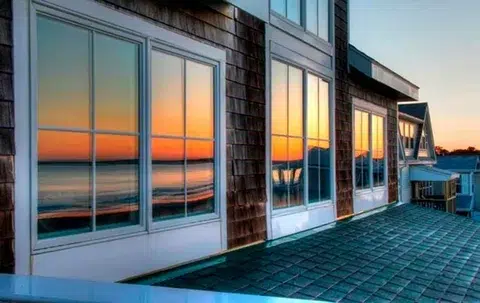 A west facing Austin home absorbing direct afternoon sun, exactly the exposure that accelerates solar pumping and seal fatigue.
Section 2: Diagnosing Failed Window Seals
The good news is that a failed seal almost always leaves clear, physical evidence, once you know what to look for.
Fog and persistent haze between the panes is the most recognizable symptom, and it means moisture has already migrated into the sealed cavity faster than the internal desiccant, a moisture absorbing material packed into the spacer bar, can manage. Once that desiccant reaches saturation, it can no longer scrub incoming humidity, and the haze becomes permanent rather than something that clears with a change in weather.
Mineral residue or streaking often appears alongside fogging, particularly after the moisture inside the cavity has cycled through evaporation and condensation multiple times, leaving behind faint white or chalky deposits on the interior glass surfaces that no amount of exterior cleaning will touch.
Drafts near the frame or sash point toward a different failure mode entirely: perimeter seal or weatherstripping failure rather than a compromised insulated glass unit. This is a convective air leak, not the conductive heat transfer issue happening inside a fogged pane, and it requires a different fix.
Section 3: How to Fix Window Sealing in Austin
Once you have identified which type of failure you are dealing with, the correct fix depends entirely on where that failure originated, and this is where a lot of homeowners get steered toward the wrong (and more expensive) solution.
Perimeter frame caulking addresses convective leaks at the point where the window frame meets the wall, or along the sash weatherstripping. This is a targeted, relatively inexpensive fix: removing the old, degraded sealant down to a clean substrate, and applying a new bead of high grade silicone or polyurethane sealant matched to the surrounding material. It does nothing, however, to address a fogged or hazy insulated glass unit, since that failure is happening inside a sealed cavity the caulking cannot reach.
Insulated glass unit (IGU) replacement is the correct fix when the primary seal inside the sealed cavity itself has failed, evidenced by fogging, haze, or mineral residue between the panes. This involves replacing the glass unit within the existing frame, a precise job requiring exact measurements and proper reseating, but critically, it does not require tearing out the entire window frame if that frame remains structurally sound.
 A technician measuring a window opening before fitting a replacement insulated glass unit into an existing Austin home frame.
| Seal Failure Type | Common Symptoms | Correct Solution |
|---|---|---|
| IGU primary seal failure | Persistent fog, interior haze, mineral streaking between panes | Glass unit replacement (frame typically reusable) |
| Perimeter caulking failure | Draft near frame edge, visible cracking in exterior caulk line | Strip and reseal with silicone or polyurethane sealant |
| Sash weatherstripping wear | Draft felt specifically when window is closed, whistling in wind | Weatherstripping replacement along the moving sash |
| Frame warped from foundation shift | Window difficult to open or close, visible gap at one corner | Frame realignment or, in severe cases, full frame replacement |
Section 4: DIY Window Sealing vs. Professional IGU Replacement
There is real, worthwhile DIY work available to an Austin homeowner, and knowing where that work stops is just as important as knowing where it starts.
Perimeter caulking is genuinely approachable as a DIY project. Removing old, cracked caulk with a scraper, cleaning the substrate thoroughly, and applying a fresh bead of quality silicone sealant is well within reach for a patient homeowner with the right tools, and it directly resolves the majority of draft related complaints around a window frame. Weatherstripping replacement on a sash is similarly approachable, provided you can source the correct profile and width for your specific window system.
Where DIY runs into real trouble is anything involving the sealed glass cavity itself. A fogged IGU cannot be fixed by drilling a hole to release trapped moisture, a home remedy that occasionally circulates online. This approach permanently destroys whatever remains of the argon fill, often introduces new points of failure, and in many cases risks cracking the tempered glass outright. Insulated glass units are precision manufactured and sealed with specialized equipment that simply is not available at the consumer level, and a proper replacement requires exact measurements, careful handling of a heavy glass unit, and correct reseating within the existing frame to avoid introducing a new perimeter leak in the process of fixing the original one.
Section 5: Neighborhood Specific Considerations
Austin's housing stock varies dramatically by neighborhood, and that variation genuinely changes what kind of seal failure you are most likely to encounter.
Historic homes in Hyde Park and similar older, established neighborhoods often still carry original wood framed windows, sometimes retrofitted with newer insulated glass units over the decades. These frames are more susceptible to the foundation shift issues discussed earlier, since older construction methods were not engineered with the same tolerance for soil movement that modern building codes require, and wood itself expands and contracts with humidity in ways vinyl and aluminum frames do not.
Newer builds in Mueller and parts of East Austin typically feature modern vinyl or aluminum clad frames with factory sealed IGUs, and while these frames handle foundation movement somewhat better structurally, they are not immune to solar pumping or UV related seal fatigue, particularly on unshaded south and west facing exposures common in newer, more open lot developments. Homes closer to the Hill Country fringe, around Barton Creek and Westlake, tend to sit directly on the limestone and expansive clay geology that drives the most pronounced foundation related frame stress in the region, making perimeter seal failure and frame alignment issues somewhat more common there than in the flatter areas further from the escarpment. Out in Round Rock and Cedar Park, where development has been more recent and rapid, the housing stock skews newer, but summer heat exposure remains just as intense, meaning solar pumping related IGU failure is still the dominant issue homeowners in those areas tend to report.
Section 6: Frequently Asked Questions
How do I know if I need window seal fixes near me or a full window replacement?
If the frame itself remains square, free of rot, and structurally sound, a targeted glass unit replacement or perimeter reseal is almost always sufficient, and considerably less expensive than a full window replacement. Full replacement becomes necessary only when the frame has warped beyond adjustment, suffered water damage, or when a homeowner is intentionally upgrading to a higher performance glazing system across the whole house.
Why does my window fog up specifically on hot afternoons but seem to clear at night?
If fogging genuinely comes and goes with temperature, it is more likely surface condensation from a humidity differential rather than a failed internal seal, though this should still be monitored closely. True IGU seal failure, by contrast, produces a haze that stays constant between the panes regardless of the time of day or outdoor temperature, since it reflects trapped moisture inside a sealed cavity rather than a surface level condensation effect.
Is it normal for older Hyde Park homes to need seal repairs more often than newer construction?
Yes, to a meaningful degree. Older wood framed windows, even when retrofitted with modern insulated glass, tend to experience more frame movement due to both the original construction tolerances and the natural expansion and contraction of wood with humidity changes. This does not mean older homes need constant repair, but it does mean perimeter seal and frame alignment checks are worth doing somewhat more frequently than on a newer vinyl framed home.
How much does it typically cost to fix window sealing in Austin compared to full replacement?
Targeted repairs, whether that is perimeter resealing or a single IGU glass replacement, generally cost a small fraction of what a full frame and window replacement runs, since the labor and material scope is limited to the specific failed component rather than the entire assembly, structural teardown, and finish work a full replacement requires. An honest, in person inspection is the only reliable way to get an accurate number for your specific situation, since costs vary based on window size, glass type, and frame condition.
Whatever is causing the draft, the haze, or the climbing energy bill in your home, the fix is almost always more targeted and more affordable than homeowners initially assume. If you have been searching for window seal fixes near me, our team brings exactly this kind of diagnostic first approach to every visit across Austin and the surrounding communities, from Hyde Park to Round Rock and everywhere in between.


Window Seal Fixes Near Me: An Austin Homeowner’s Guide to Foggy Glass, Drafts, and Failing Frames
Window Seal Fixes Near Me: An Austin Homeowner’s Guide to...


Window Screen Repair Austin: Restoring Your Home’s Breeze Without the Bugs
Window Screen Repair Austin: Restoring Your Home’s Breeze Without the...
Explore More Dallas Door & Window Resources
Home Window Sealing & Leak Repair | Austin Professional Services...
Broken Window Lock Repair Austin TX | Fast Lock & Hardware Fix
Broken Window Lock Repair in Austin, TX Broken Window Lock...
Damaged Window Frame Repair Austin TX | Fast Frame Restoration
Broken Window Glass Repair in Austin, TX Broken Window Glass...

Fast Stuck Window Repair Austin TX | Expert Track & Frame Fix
Stuck Window Repair in Austin, TX Stuck Window Repair Austin...